Add your promotional text...



World Bank Recommendations
By Sofia VANDENBROECK | LNC
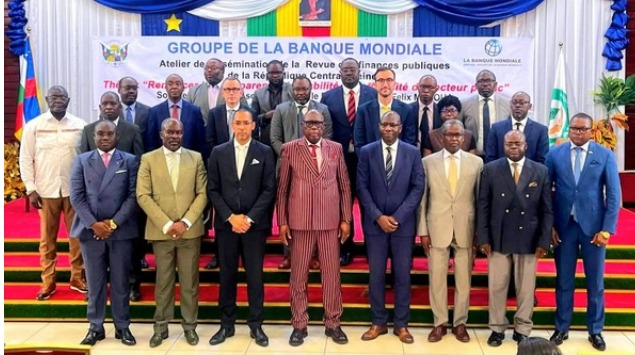
(Bangui, July 14, 2026 | LAMINE MÉDIA) – Earlier this month, World Bank representatives visited Bangui for a serious mission: organizing a workshop titled "Strengthening Transparency, Visibility, and Efficiency in the Public Sector." The event brought together government officials, technical and financial partners, and civil society representatives to assess the country's budgetary situation, which is characterized by a lack of transparency and a reliance on ad-hoc measures. Cheick Fantamady Kanté, the World Bank’s Director of Operations for Central Africa, diplomatically expressed his strong criticism regarding the management of the Central African Republic's public finances. Backed by data, he highlighted the country's heavy reliance on external sources, stating: "This dependence constitutes a vulnerability, not a development strategy." The World Bank recommends three priority areas: boosting domestic revenue mobilization by modernizing tax and customs administrations and increasing contributions from the extractive and forestry sectors; improving the quality of public spending to ensure every CFA franc invested yields tangible results; and strengthening coordination between the government and technical and financial partners to better align foreign aid with national priorities. Representing the Minister of Finance and Budget, Marc Mandaba—the Minister of Economy, Planning, and International Cooperation—acknowledged the structural weaknesses highlighted by the review. He noted, among other things, that the public sector wage bill consumes over 70% of domestic revenue, severely limiting investment in infrastructure, education, and healthcare. He also pointed out that more than 80% of public investment is funded by external partners. Although the Central African government has promised to follow the World Bank's recommendations, will it actually do so? Notably, the key measures announced include: increasing domestic revenue to 12% of GDP in the medium term, with a long-term target of 15%; modernizing and digitizing tax and customs administrations; strengthening treasury and public debt management; improving fiscal transparency through better publication of state financial documents; and gradually reorienting public spending toward social sectors and priority infrastructure. Among the non-binding pledges are: strengthening taxation in the mining, forestry, and telecommunications sectors; combating unjustified tax exemptions; and expanding electronic payment systems to improve revenue collection. These recommendations were presented to Prime Minister Félix Moloua, who advocated for better integration of the informal sector into public policies. Ministers Aurélien Simplice Kongbelet Zingas (National Education) and Rufin Benam Beltoungou (Mines and Geology) also offered several observations to further refine the proposed reforms.
For: LAMINE MEDIA (in FR and GB)
Date: July 14, 2026
x= x.com/...
Facebook = facebook.com/...
Copyright ©: 2013 - 2026 All rights reserved: LAMINE MEDIA
SIGN UP FOR OUR NEWSLETTER
contact@laminemedia.com
+33 06 13 98 02 86
© 2025. LAMINE MÉDIA All rights reserved.